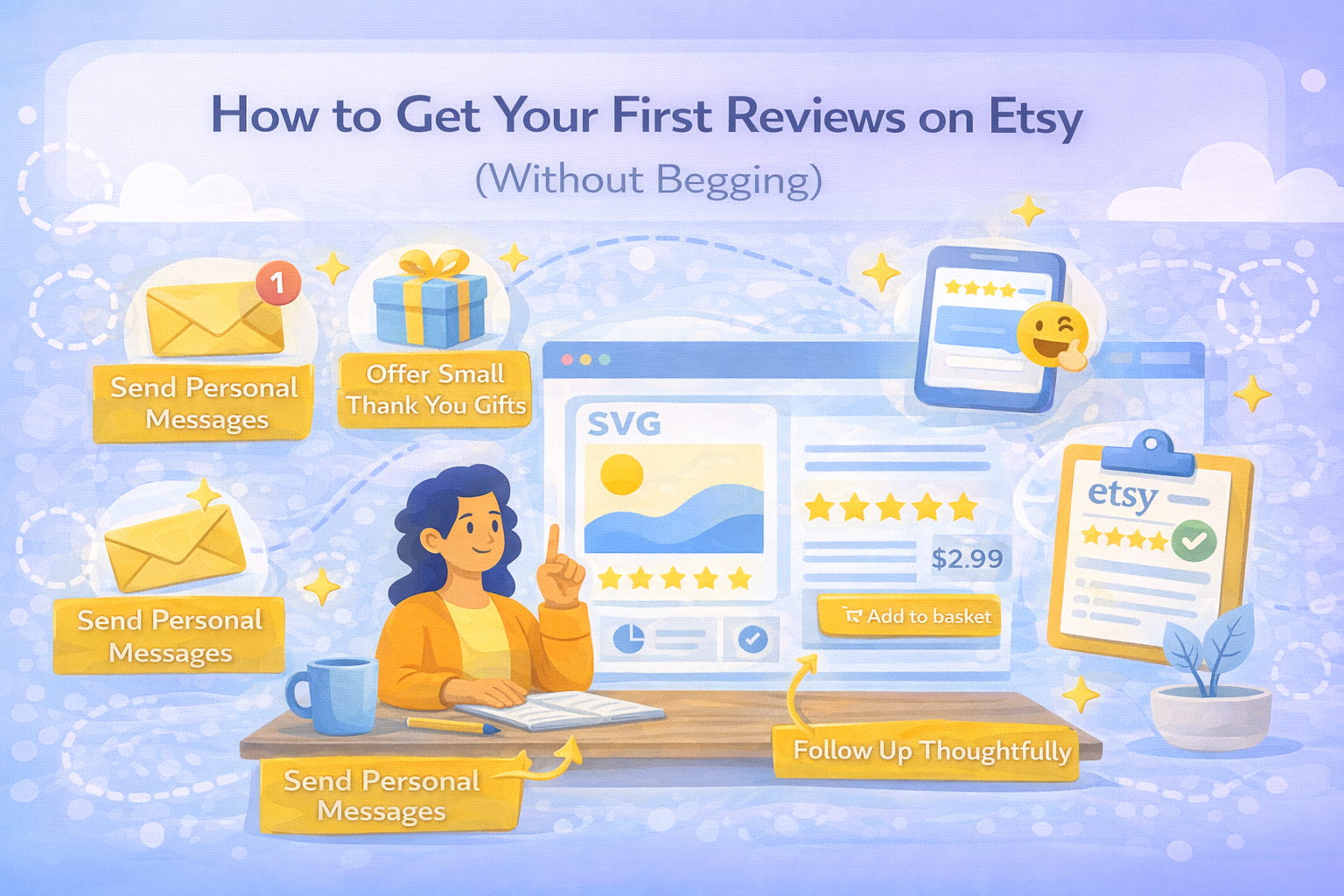
Reviews are one of the first things a buyer checks before purchasing from a shop they haven't bought from before. A new listing with zero reviews is at a real disadvantage — but it doesn't stay that way for long if you approach it strategically.
Why Reviews Matter More Than Most Sellers Realise
Reviews do two things simultaneously: they build trust with buyers, and they signal to Etsy's algorithm that your listing is worth ranking higher.
From a buyer's perspective, a listing with 20 five-star reviews feels safe. A listing with zero reviews requires a leap of faith. Most buyers won't take that leap when there are reviewed alternatives available — especially for a seller they've never heard of.
From an algorithm perspective, reviews feed your listing quality score. A listing that accumulates positive reviews consistently will climb in search rankings over time, getting more visibility, more clicks, and more sales — a compounding cycle that starts with that first handful of reviews.
This is why getting your first 5–10 reviews fast matters more than slowly accumulating 50 reviews over a year.
Pricing Strategically to Get Early Sales
You can't get reviews without sales first. For brand new listings, a slight launch discount — 15–20% off your standard price — lowers the barrier for first-time buyers who don't yet have reviews to rely on as social proof.
This isn't about permanently undercutting yourself. It's a short-term tactic to generate the initial sales that lead to initial reviews. Once you have 10–15 reviews, return to your normal pricing. The reviews do the trust-building work that the discount was doing.
If you have multiple new listings, stagger your launch discounts rather than discounting everything at once. Pick your strongest 3–5 listings and focus your early efforts on building reviews there first.
The Follow-Up Message: What to Say
Etsy allows sellers to send one follow-up message to buyers after a purchase. Used well, this is your most direct route to a review. Used poorly, it feels pushy and gets ignored.
Here's a message template that works:
Hi [first name],
Thanks so much for your purchase — I hope the files downloaded easily and work perfectly for your project.
If you have any questions or run into any issues, just message me and I'll sort it out quickly.
If you get a moment to leave a review, it genuinely means a lot to a small shop. Either way, enjoy the design!
[Your name]
A few things to notice about this template:
- It leads with helpfulness, not the review request — this sets the right tone and reminds the buyer you're a real person who cares
- It makes the review ask feel low-pressure — "if you get a moment" removes obligation; the buyer feels free to say yes or skip it
- It stays short — buyers don't read long messages; this fits on one screen
- It doesn't offer incentives for reviews — Etsy's policies prohibit incentivised reviews, and violating this can get your shop suspended
Send this message 3–4 days after purchase. By then, most buyers will have downloaded and used the file, and the experience is fresh enough that they're likely to leave feedback.
What Etsy's Policies Actually Say
It's worth knowing the rules clearly so you don't accidentally cross a line:
- You can ask buyers to leave a review
- You cannot offer discounts, freebies, or any incentive in exchange for a review
- You cannot ask buyers specifically for a positive review — just ask for honest feedback
- You cannot send multiple follow-up messages asking for a review on the same order
Stay within these boundaries and you're fine. The template above is fully compliant.
Review Velocity: Why Getting 5 Fast Beats 50 Slowly
A listing that gets 5 reviews in its first two weeks signals to Etsy that it's a popular, engaging product. A listing that gets 50 reviews spread across two years tells a different story.
Early review velocity influences how quickly Etsy promotes your listing in search results. It also creates a visible credibility signal for buyers who discover you in those early weeks — when a listing is new, a handful of recent positive reviews can be the difference between a click and a scroll-past.
This is why it's worth focusing energy on a small number of listings when you're starting out, rather than spreading yourself thin across dozens. Get 5–10 listings to 10+ reviews each before expanding aggressively.
Handling Negative Reviews: The Right Approach
Negative reviews happen to every seller eventually. How you respond matters more than the review itself.
Respond calmly and publicly. Every response you write is visible to future buyers. A gracious, problem-solving response to a negative review actually builds trust — it shows you're professional and you stand behind your products.
A good response framework:
- Acknowledge the buyer's frustration without being defensive
- Explain what you've done or offered to resolve it
- Keep it brief — one or two sentences is enough
Example: "So sorry to hear the files didn't work as expected — I've sent you a message with an alternative format that should fix the issue. Happy to help further if needed."
What not to do:
- Don't argue with the buyer in your public response
- Don't explain at length why the buyer was wrong
- Don't ignore the review — silence looks worse than a measured response
In most cases, offering a quick, genuine solution will prompt the buyer to update their review. Even when it doesn't, future buyers will see how you handled it.
Preventing Bad Reviews Before They Happen
The best review strategy is a listing that sets accurate expectations so buyers are never disappointed.
- Clear images that show exactly what the design looks like — no surprises on download
- Explicit file format information in the description and in an image — no "I didn't know it was only SVG"
- An FAQ section in your description covering the most common questions: how to download, compatible software, what commercial use means
- Fast, friendly responses to pre-purchase questions — buyers who feel well-served before they buy are more likely to leave a good review after
Most negative reviews for digital downloads come from mismatched expectations, not from bad products. Fix the expectation gap and you'll fix most of your review problems before they start.
Quick Summary
- Getting your first 5–10 reviews quickly matters more than accumulating them slowly — early velocity builds both trust and ranking
- Use a short launch discount to generate initial sales that lead to initial reviews
- Send one polite follow-up message 3–4 days after purchase — lead with helpfulness, ask for a review without pressure
- Never offer incentives for reviews — it violates Etsy's policies
- Respond to negative reviews calmly and publicly — future buyers will see how you handle problems
- Prevent bad reviews by setting accurate expectations through clear images, explicit file info, and an FAQ section
SVGenie generates ready-to-list Etsy descriptions, titles, and tags alongside your SVG files — try it free.