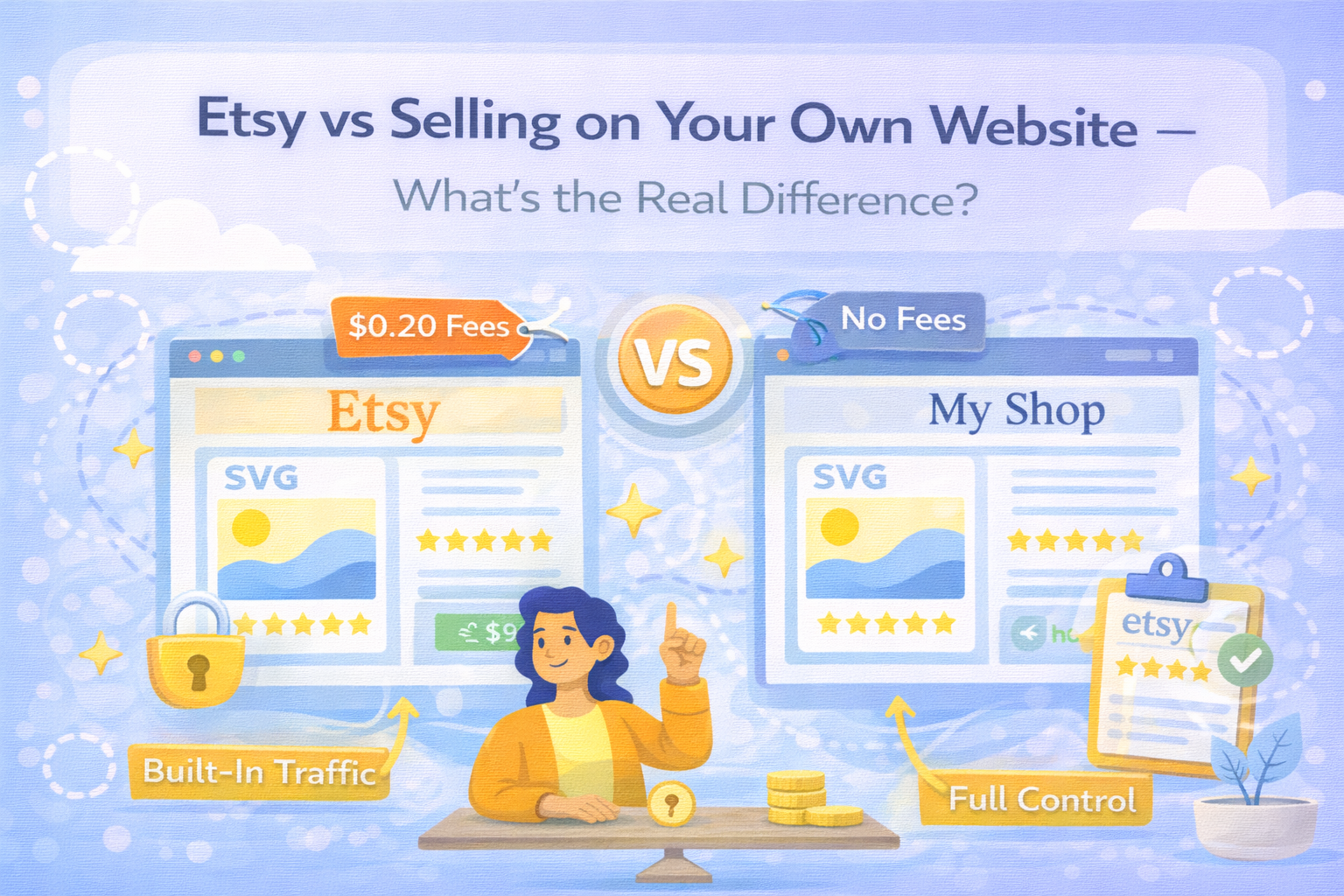
At some point, most Etsy sellers wonder whether they'd be better off running their own store. No fees, full control, keep everything you earn. It sounds appealing — but the full picture is more nuanced than that. Here's an honest comparison so you can make the right call for where you are right now.
What Etsy Does Well
Etsy's biggest advantage isn't its features or its interface. It's the traffic. Etsy attracts hundreds of millions of buyers every year who are already in a purchasing mindset, already searching for exactly the kinds of products you sell. That buyer intent is extraordinarily valuable — and it's not something you can replicate overnight on your own.
For a new seller, this matters enormously. On Etsy, you can publish a well-optimised listing today and have your first sale within days. On your own website, you'd need to build an audience first — which typically takes months of consistent effort before you see meaningful results.
Etsy also provides built-in trust. Buyers who've never heard of your shop feel comfortable purchasing because Etsy's brand, buyer protection, and review system give them confidence. On your own site, you're starting from zero on that trust dimension.
What Etsy Costs You
Etsy's advantages come with real costs, and it's worth knowing exactly what you're paying:
- Listing fee: $0.20 per listing, renewed every four months or when a listing sells
- Transaction fee: 6.5% of the total sale price (including shipping, though digital downloads have no shipping)
- Payment processing fee: approximately 3% + $0.25 per transaction (varies slightly by country)
On a $5 digital download, you're paying roughly $0.55–$0.65 in fees — around 11–13%. That's not ruinous, but it adds up at volume.
Beyond fees, there are structural costs that don't show up on an invoice:
- No customer relationship. Etsy owns the buyer relationship, not you. You can't email your past customers directly, run your own promotions to them, or easily bring them back. If you build a successful shop and Etsy changes its algorithm or policies, your business is affected in ways you can't control.
- Policy changes. Etsy has made significant policy changes over the years — fee increases, search algorithm overhauls, new rules around digital products. Each one affects sellers whether they like it or not.
- Competition within the platform. You're not just competing for buyers — you're competing for visibility within a marketplace that also promotes your competitors' listings right next to yours.
What Your Own Website Does Well
The core advantage of your own store is control. You set the rules, you keep the revenue (minus payment processing, typically 2–3%), and you own the customer relationship.
With an email list built through your own store, you can reach past buyers directly — announce new designs, run your own sales, build loyalty that doesn't depend on a third-party algorithm. Over time, this is worth far more than the fee savings.
Your own store also lets you build a brand in a way Etsy doesn't allow. Your domain, your design, your customer experience from first visit to download confirmation. For sellers who want to grow beyond a side hustle into a recognisable business, that eventually matters.
Platforms like Gumroad and Payhip are worth mentioning here — they sit somewhere between "own website" and "marketplace." They give you your own storefront with very low fees (Payhip's free plan charges 5% per sale; paid plans reduce this to zero), and they handle delivery of digital files automatically. They don't bring you traffic, but they're a low-friction way to start building an off-Etsy presence.
What Your Own Website Costs You
The hard truth: traffic. Every single visitor to your own website has to come from somewhere you've created or paid for — Google SEO, Pinterest, social media, paid ads, email. None of these channels are free in terms of time or money, and none of them deliver results overnight.
Most sellers who try to launch their own website before building an audience end up with a store that gets almost no visitors. The product might be excellent. The store might look professional. But without traffic, it doesn't matter.
This is why timing matters. A standalone store works best when you already have an audience to direct to it — not as a way to build one from scratch.
The Realistic Path Forward
For most SVG sellers, the smart sequence looks like this:
Phase 1 — Build on Etsy. Get your first 50–100 listings live, accumulate reviews, learn what niches and designs sell well, and generate consistent monthly revenue. Etsy's built-in traffic does the heavy lifting while you figure out your product-market fit.
Phase 2 — Start building off-Etsy assets. Once you have steady sales, start a Pinterest account and pin your designs consistently — Pinterest is one of the best free traffic sources for digital download sellers. Begin collecting buyer emails if you can (Etsy limits this, but you can include a note in your download files pointing buyers to a freebie on your own site in exchange for an email address).
Phase 3 — Diversify. When you have an email list and Pinterest presence sending reliable traffic, add a Gumroad, Payhip, or Shopify store. You're not replacing Etsy — you're adding a channel you control alongside it.
Most successful digital download sellers run Etsy and their own platform in parallel. Etsy brings new buyers. Their own platform retains them.
A Note on Multi-Platform Selling
Selling on both Etsy and your own site with the same products is generally fine — there's no exclusivity requirement. Some sellers also list on platforms like Creative Market (which does have editorial standards for acceptance) to add another traffic source.
The risk of spreading too thin is real, though. Managing multiple storefronts, each requiring its own SEO and maintenance, is work. For most sellers in the early stages, one platform done well beats three platforms done poorly.
Quick Summary
- Etsy's main advantage is built-in buyer traffic and trust — invaluable when you're starting out
- Etsy fees run roughly 11–13% per sale, plus the loss of customer relationship and platform dependency
- Your own website offers full control and higher margins but requires you to generate 100% of your own traffic
- Platforms like Gumroad and Payhip offer low-fee alternatives with no built-in traffic
- The smart path: build on Etsy first, grow off-Etsy assets (Pinterest, email list) in parallel, then diversify
- Running Etsy alongside your own store is common and sensible — they serve different purposes
SVGenie generates ready-to-list Etsy descriptions, titles, and tags alongside your SVG files — try it free.